
August 11, 2025

Hypertensive Emergency: ICD-10-CM FY 2025 Sequencing and Coding Guidance

What Is a Hypertensive Emergency?

Hypertensive Emergency is a severe increase in high blood pressure (typically greater than 180 systolic/120 diastolic) with potentially life-threatening symptoms or damage to vital organs. 


**In FY 2025, new sequencing instructions were added to ICD-10 for hypertensive emergency.** 
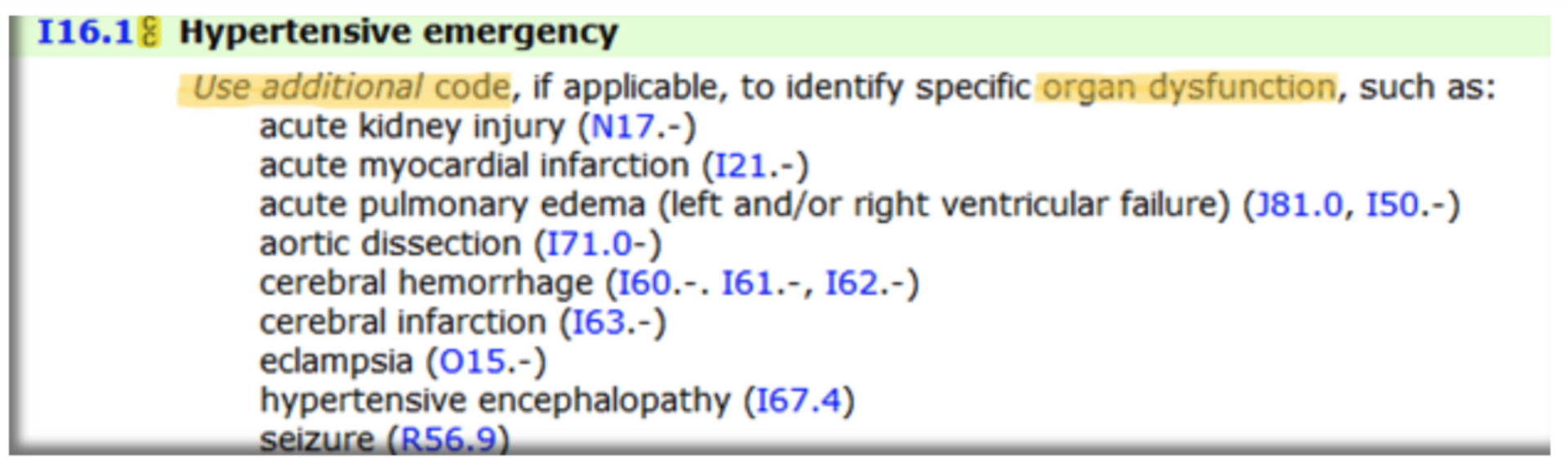
ICD-10-CM Tabular List entry for I16.1 hypertensive emergency showing the “Use additional code” instruction to report associated organ dysfunction.

The Tabular List “Use Additional code” instructional note for hypertensive emergency must be followed when supported in documentation, which includes CDI query responses.  Hypertensive emergency I16.1 is appropriately sequenced as Principal Dx if an associated organ dysfunction / manifestation is documented. 


Documentation and Cause-and-Effect Considerations

Cause-Effect documentation may be in one concise statement or  within the context of several narrative statements indicating CVA, CHF exacerbation, etc. is a manifestation of hypertensive emergency. 

{Code also any identified hypertensive disease (I10-I15, I1A) as instructed by ICD-10 tabular}. 



Katie Brown, CCS, Senior Consultant, Audit at UASI

Katie Brown, CCS 

Senior Consultant, Audit at UASI


Katie Brown, CCS, is an AHIMA-certified Senior Coding Consultant specializing in CPT/ICD-10 coding, compliance audits, and revenue cycle support. She’s worked across diverse outpatient and inpatient settings, including ER, surgery, observation, and specialty clinics, and enjoys training coders with practical, CDI-friendly tips. 


Works Cited

BMJ Best Practice. (2025). Hypertensive emergencies: Symptoms, diagnosis, and treatment. Available at:
https://bestpractice.bmj.com/topics/en-us/27


Centers for Disease Control and Prevention. (2025). ICD-10-CM Tabular List of Diseases and Injuries. Available at:
https://www.cdc.gov/nchs/icd/icd-10-cm/index.html



Child with cerebral palsy smiling during therapy activity with motor impairment and supportive care.
By Katie Curry January 26, 2026
Support accurate cerebral palsy ICD-10-CM coding with CDI guidance on clinical indicators, documentation requirements, and physician query opportunities.
CDI Tip Title Graphic, mom and baby sleeping text reads
By Katie Curry January 13, 2026
Clarify apnea of prematurity clinical indicators, treatment considerations, and CDI coding guidance to support accurate neonatal documentation and query decisions.
MRI brain scans illustrating symptoms of PRES with title text overlay.
December 9, 2025
Learn the symptoms of PRES, key treatment considerations, ICD-10-CM code I67.83, and documentation tips for CDI and accurate DRG assignment.
Microscopic immune cells interacting in cellular environment, illustrating immune effector activity
By Katie Curry December 1, 2025
Understand ICANS documentation and ICD-10 coding with guidance on the ICANS grading system, ICE score, clinical indicators, and CAR T-cell neurotoxicity.
Fingerstick blood glucose test being performed, illustrating screening and monitoring practices for gestational diabetes.
By Katie Curry November 3, 2025
Define gestational diabetes documentation requirements, key risk factors, and clinical details needed to support accurate ICD-10 coding, severity capture, and quality reporting.
Clinician pointing to anatomical kidney model illustrating acute kidney injury.
By Katie Curry October 20, 2025
Learn how to identify, document, and code acute kidney injury (AKI), including diagnostic criteria, staging, ICD-10-CM guidance, and CDI query considerations.
Blurred hospital scene symbolizing CDI review of firearm injury intent reporting.
By Katie Curry September 30, 2025
Learn how firearm injury intent is documented and reported in ICD-10-CM, including intent categories, external cause codes, and documentation considerations.
Title image for the ventricular standstill clinical documentation and coding overview
By Katie Curry September 22, 2025
Learn how ventricular standstill is documented and coded, including clinical indicators, ICD-10-CM guidance, and common documentation considerations.
Title image for neurostorming (PSH) documentation and coding
By Katie Curry September 7, 2025
Learn how neurostorming, also known as paroxysmal sympathetic hyperactivity (PSH), is documented and coded using ICD-10-CM guidance.
Title photo of doctor for New ICD-10-CM code E11.A for type 2 diabetes mellitus in remission
By Katie Curry August 7, 2025
FY 2026 ICD-10-CM coding guidance for new code E11.A, Type 2 diabetes mellitus without complications in remission, including documentation and query considerations.
Show More