
Tracy Blevins, MSHIM, RHIA • October 9, 2025
Accurate Egg Allergy Coding
With the FY 2026 update, ICD-10-CM adds more specificity for egg allergies and reactions — especially distinguishing tolerance vs reactivity to baked egg.
Here are the key new (or revised) codes:
T-codes (for adverse reactions / anaphylaxis) - These go in Chapter 19: Injury, Poisoning and Certain Other Consequences of External Causes (T66–T78 etc.):
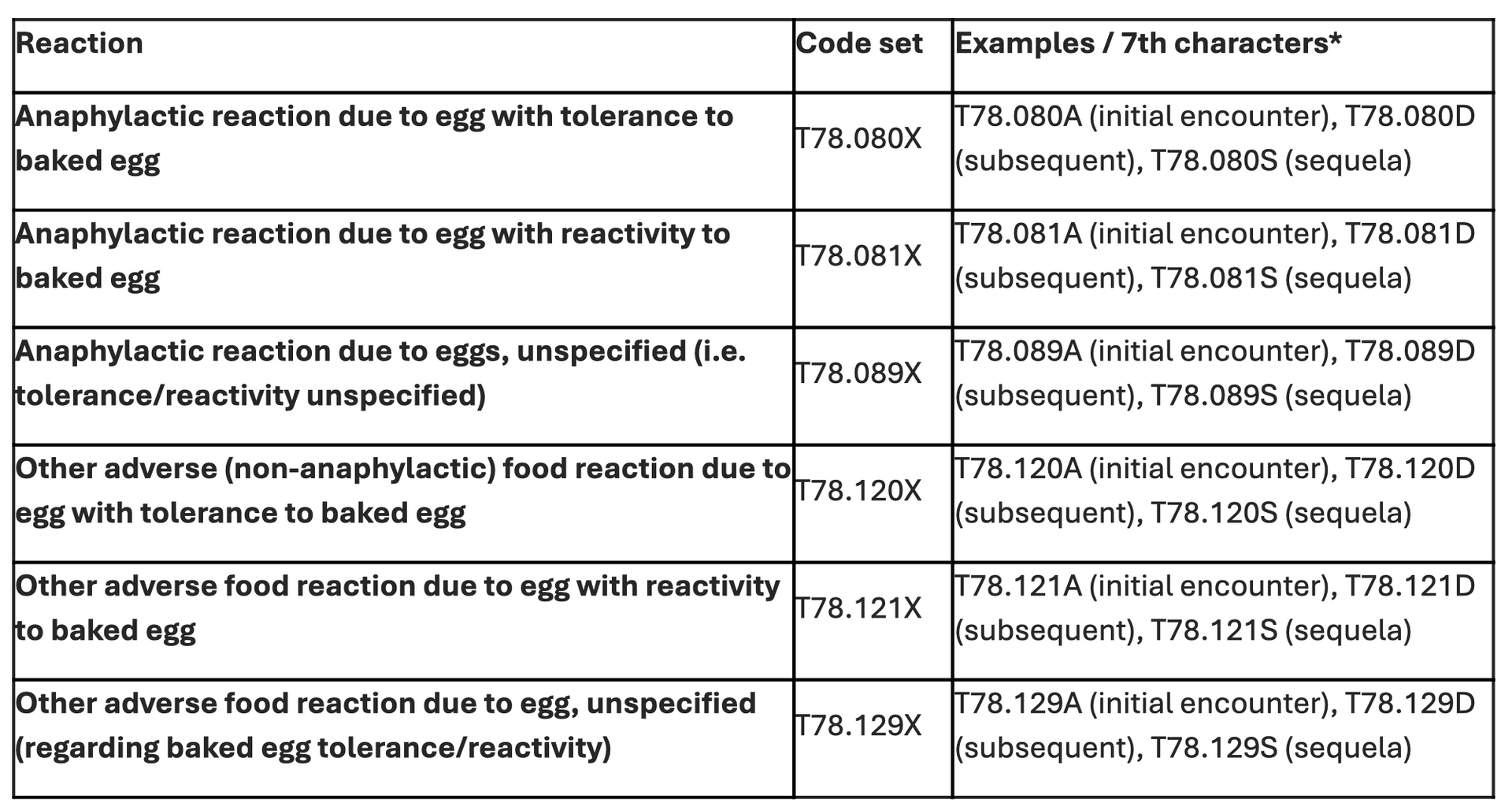
* “X” is a placeholder for the 7th character (A = initial, D = subsequent, S = sequela).
So, the prior “umbrella” codes for anaphylaxis or adverse food reaction due to eggs, are being deleted or replaced in favor of more detailed ones.
Z-codes (allergy status / history codes)
These go in Chapter Z (Factors influencing health status), under “Allergy status, other than to drugs and biological substances”:
- Z91.0120 — Allergy to eggs, unspecified
- Z91.0121 — Allergy to eggs with tolerance to baked egg
- Z91.0122 — Allergy to eggs with reactivity to baked egg
These Z-codes reflect a patient’s allergy status or history, not necessarily an acute reaction but recognition that the allergy exists (and whether they tolerate or react to baked egg).
The old parent code Z91.012 (“Allergy to eggs”) is being deleted / replaced by this more granular trio.
What This Means in Practice & Documentation Tips
To code correctly under the new scheme:
Know whether it's an acute reaction or just allergy status.
- If it's an acute allergic reaction / anaphylaxis / other reaction, use a T-code.
- If it's merely documenting a known allergy status or history, use a Z-code.
Specify baked egg tolerance/reactivity if known.
The key new distinction is whether the person
tolerates baked egg
or
has a reaction to baked egg
(versus unspecified). Any documentation you have should note baked egg status (e.g. “patient tolerates baked egg,” or “patient has reactions to baked egg”) to allow assigning the more specific code.
Select the correct 7th character for T-codes.
- A = initial encounter
- D = subsequent (follow-up)
- S = sequela (late effect)
Make sure your documentation reflects timing and encounter context.
Avoid using the old generic codes once deleted.
Old umbrella codes (e.g. T78.08XX for eggs, T78.1 for other adverse food reactions) will be invalid for claims after October 1, 2025.
Query when needed.
If the record doesn't specify whether the reaction was to baked egg or tolerance versus reactivity, query the provider for clarity so you can pick the correct new code rather than default to “unspecified.”
Check consistency with clinical notes and allergy testing.
Lab results, allergy challenge notes, or physician narrative may help you determine baked egg status.

Tracy Blevins, MSHIM, RHIA
Senior Consultant, Audit at UASI
Tracy Blevins is a Senior Consultant in Quality Auditing at UASI, with 14+ years of inpatient medical coding and health information management experience. As a Registered Health Information Administrator that also holds AHIMA’s Auditing Inpatient Coding Microcredential, she shares practical, detail-driven coding tips to help clinicians and coders strengthen documentation, accuracy, and compliance.
Works Cited
American Academy of Allergy, Asthma & Immunology. (2025, September). 2026 code updates.
Available at
https://college.acaai.org/2026-code-updates/
Association of Clinical Documentation Integrity Specialists (ACDIS). (2025). CMS releases FY 2026 ICD-10-CM code update.
Available at
https://acdis.org/articles/news-cms-releases-fy-2026-icd-10-cm-code-update
Centers for Medicare & Medicaid Services. (2025). FY 2026 ICD-10-CM Official Guidelines for Coding and Reporting.
Available at
https://www.cms.gov/files/document/fy-2026-icd-10-cm-coding-guidelines.pdf